RoboWolf
How China is Redefining Ground Warfare with Armed Quadruped Robots

Introduction
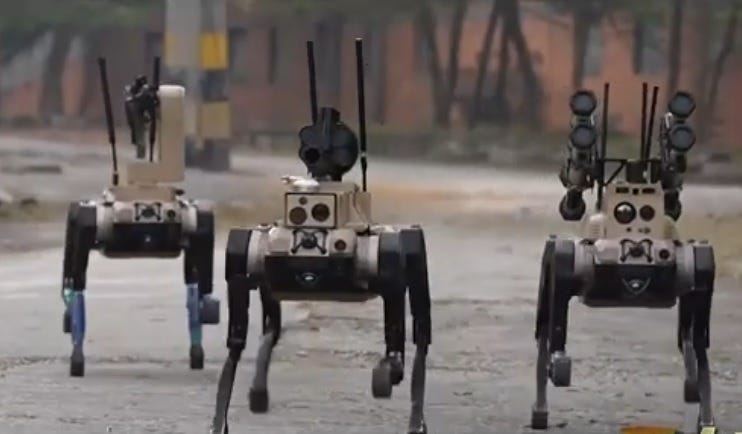
In March 2026, the People’s Liberation Army presented one of its most comprehensive demonstrations to date: the complete family of armed quadruped robots known as RoboWolf (狼群 - Lángqún). For the first time, all the main variants were shown operating together in public.
Here is the official demonstration video:
What we saw was not a single experimental robot, but a complete tactical system. This marks a significant leap in Chinese military doctrine
Part 1 – What Was Actually Shown
The RoboWolf family includes several operational configurations:
Logistics/Transport version: Unarmed, focused on carrying supplies or equipment over difficult terrain.
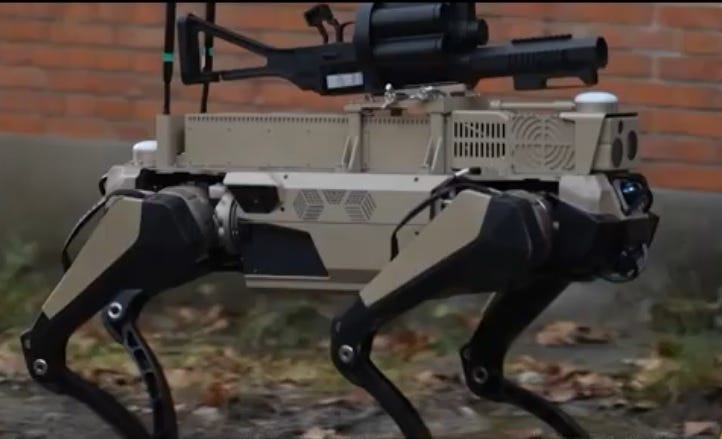
Standard carbine version: Fixed mounting of the QBZ-191, the current assault rifle of the PLA.
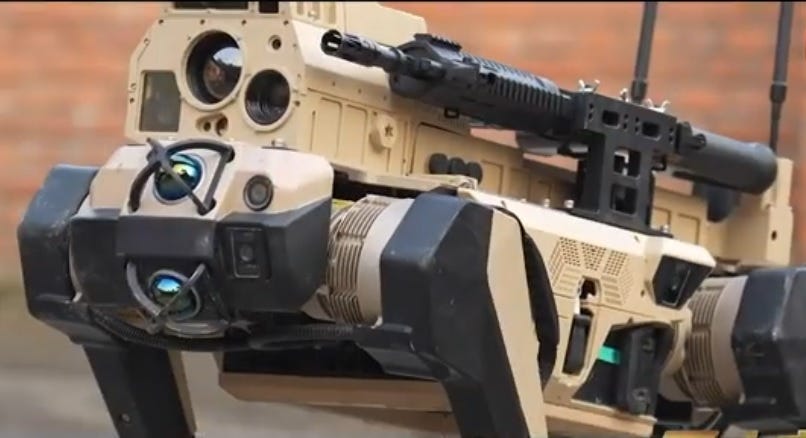
Movable pedestal carbine version: The weapon can rotate and elevate independently of the robot’s body, allowing suppressive fire while on the move.
Fiber-optic carbine version: Likely intended for special operations or environments with strong electronic interference.
Grenade launcher version: Automatic 40 mm launcher mounting.
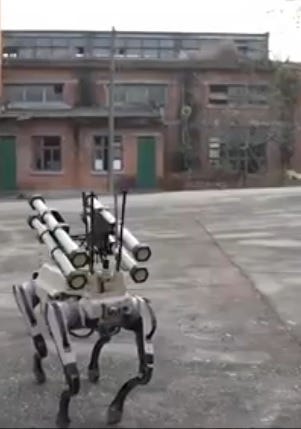
Quadruple rocket launcher version: Small ~10 mm rocket system, ideal for close-range saturation or signaling.
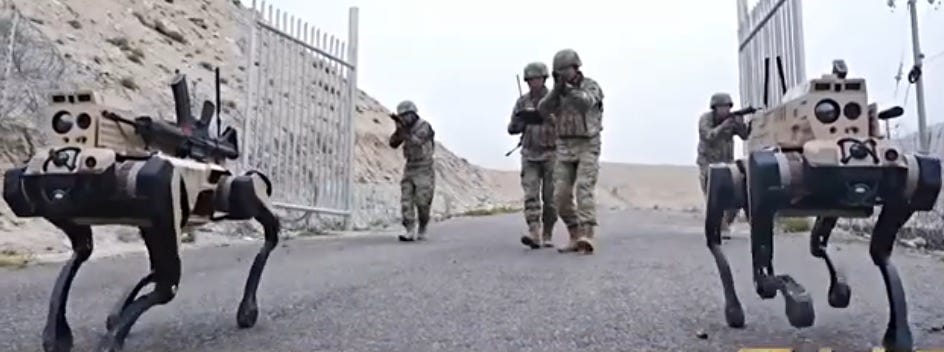
The most interesting aspect of the system is the control method: soldiers can directly command the robot using a joystick integrated into the sight of their own rifle, without needing to look at a separate screen. This drastically reduces reaction time and improves soldier-robot coordination. Hand gestures for quick instructions were also observed.
Although Unitree Robotics (the main company behind the platform) has not published the full technical specifications of the military version (exact height, weight, real autonomy, maximum speed, or precise payload), the RoboWolf appears to retain the robustness and agility of the civilian B2 platform, adapted to carry light weaponry while maintaining good mobility in complex terrain. Similarly, WOUBA Intelligent Technology (58 Intelligent Tech), the state-owned company based in Hangzhou responsible for the combat AI software and codes, has not released public data either. The system seems designed for environments where reducing human risk and saturating the battlefield with low-cost units is prioritized.
Part 2 – Real Implications and Limitations
The RoboWolf represent a clear trend: reducing human exposure in the early phases of combat through low-cost, high-availability robotic systems.
Obvious advantages:
Relatively low cost compared to a trained soldier.
Ability to operate in difficult terrain (ruins, mountains, contaminated zones).
Sacrificial capability without political or moral cost.
Current limitations, for now:
Still limited autonomy and speed.
Dependence on communications (vulnerable to jamming).
Reduced payload capacity (difficult to carry large amounts of ammunition or heavy explosives).
Need for a nearby human operator (still not fully autonomous).
China appears to be betting on saturating the battlefield with hundreds or thousands of these cheap systems, combined with drones and traditional fire support. They are not seeking to replace the soldier, but to multiply him.
The message is clear: the next ground war will not be fought only between humans, but between humans supported by swarms of cheap and disposable machines.
Part 3 – Doctrinal Hypothesis: How These Robots Could Be Used
Beyond the demonstration, it is worth exploring how a modern army might integrate these systems into real operations. Here are three plausible hypothetical scenarios:
Scenario 1: Platoon Assault Support (Close and Urban Combat)
A platoon of infantry advances toward an enemy position. Two RoboWolf lead the way: one equipped with a movable pedestal carbine for suppressive fire and another with a grenade launcher. The robots enter buildings or dangerous corners first, significantly reducing soldiers’ exposure. The operator keeps the joystick on his rifle, allowing him to fire while directing the robot’s fire.
Scenario 2: Advanced Reconnaissance and Tactical Decoy
Before a major advance, several light RoboWolf equipped with sensors and a carbine are deployed. They move up to 800–1,000 meters ahead of the main force. If they detect enemy positions, they open brief fire to force the adversary to reveal their location and strength. This allows friendly artillery or drones to strike with precision, minimizing human casualties.
Scenario 3: Integrated Support for Armored Units
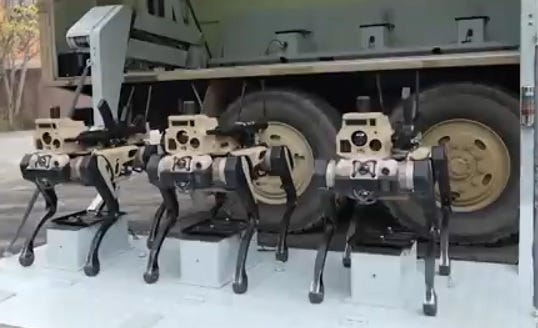
A Chinese ZTZ-20 main battle tank (two-person crew) carries four compact, launchable side containers specifically designed to transport quadruped robots. Given the ZTZ-20 hull width (approx. 3.5 meters) and the RoboWolf platform size (based on Unitree’s B2, approximately 70–85 cm tall and 1.1–1.2 m long), it is feasible to mount two robots per side without seriously compromising mobility or center of gravity, provided the containers are low-profile and mounted close to the tracks.
As the tank approaches a contact zone, it releases the four RoboWolf in a controlled manner from inside. The platoon configuration is as follows:
1 Shadow unit: Primarily equipped with advanced sensors and a high-resistance fiber-optic control cable (similar to the Xinkaitech model you sell). This cable prevents electronic interference and jamming, allowing stable control even in strong electronic warfare environments. Its main role is advanced reconnaissance and real-time data relay.
2 Light attack units:
One armed with a standard carbine (QBZ-191) mounted on a movable pedestal, capable of rotating and elevating to provide suppressive fire while moving.
Another equipped with a quadruple rocket launcher (~10 mm), ideal for close-range saturation or forcing the enemy to reveal themselves.
1 Modified Polar unit: This unit carries a significant explosive charge (C4 or equivalent military explosive) and is configured as a kamikaze unit. Its mission is to head toward high-value targets detected (armored vehicles or enemy wheeled units) and detonate to damage or immobilize them.
Development of the Scenario
Once released, the four RoboWolf quickly advance up to 800–1,000 meters ahead of the tank. The Shadow unit moves first, exploring suspicious positions and sending images and data via the fiber-optic cable to the tank commander. If threats are detected, the two light attack units position themselves to open fire: the carbine provides continuous suppression while the rocket launcher fires salvos to saturate or force the enemy to move.
If a high-value target is identified (for example, an enemy tank or command vehicle), the modified Polar unit heads directly toward it, using its quadruped mobility to bypass obstacles. Once close, it detonates its explosive charge, sacrificing itself to damage or destroy the target.
Meanwhile, the ZTZ-20 tank remains in a safer position, using the real-time data from the Shadow unit to decide its own advance or provide support with its main gun. This tactic allows the tank to project force and reconnaissance at a distance without excessively exposing its crew.
Conclusion of Scenario 3
This configuration turns the ZTZ-20 tank into a command and support platform that projects a small robotic platoon controlled via high-resistance fiber-optic cable. The result is a low-cost capability for reconnaissance, suppression, and suicide attack that forces the enemy to expend ammunition and reveal positions without exposing human crews.
This concept combines the advantages of robots (low cost, expendable, good mobility in complex terrain) with the firepower and protection of the main battle tank, creating a manned-unmanned hybrid system that multiplies the effectiveness of the armored platoon.
Although real limitations still exist (autonomy, explosive payload weight, and the need for a nearby operator), the concept demonstrates the direction China is taking: multiplying battlefield presence with cheap, expendable, and electronically hard-to-neutralize systems.
In short, four well-coordinated RoboWolf can transform a single tank into a much more versatile and lethal unit, anticipating the future of hybrid manned-unmanned armored warfare.
robot swarms are the logical extension of drone swarm technology. the AI software will be similar as well. as explored in the article, there are multiple roles the RoboWolf can play and the real strength will come when massed swarms with autonomous coordination can be deployed.